

A prompt is a text request — your direct instruction to an AI model. It sets the direction for the model's "thinking" and defines the format of the result. In effect, it's a brief, and the quality of that brief determines how well the task gets done.
Here's why it's worth learning to write effective prompts:
- Accuracy and relevance. A well-formulated prompt gets you more accurate and useful answers from the model.
- Time savings. Clear, specific requests cut down on the need for follow-up clarifications and corrections.
- Maximum efficiency. Effective prompts help you unlock the full potential of AI models, making them far more productive to use.
In this article we'll cover the principles of writing effective prompts, common mistakes to avoid, and tools and techniques for crafting high-quality requests. We'll walk through examples of successful prompts and break down why they work.
The goal of this article is to help you learn to phrase prompts so you can get the most out of text-based AI models and consistently get the best results from them.
Core principles of writing prompts
So the AI doesn't "hallucinate" and delivers a good result on the first try, follow these rules when composing requests.
Set a role and provide context
Specify the role you want the model to take on when generating its answer, and add context around your task. This helps the AI better understand the type of response you're expecting.
- For example, if you want to learn Spanish, start the prompt by assigning a role: "You are an experienced Spanish teacher."
- Then add context: "I want to learn Spanish to a B2 level over the next 6 months. Right now my Spanish is at an A1 level. I can only study for 1 hour a day."
- Only after that describe the task: "Write a 6-month study plan that includes grammar, vocabulary, listening, and speaking practice."
This approach lets the model understand your needs more precisely and provide the most relevant recommendations.
Clarity and specificity
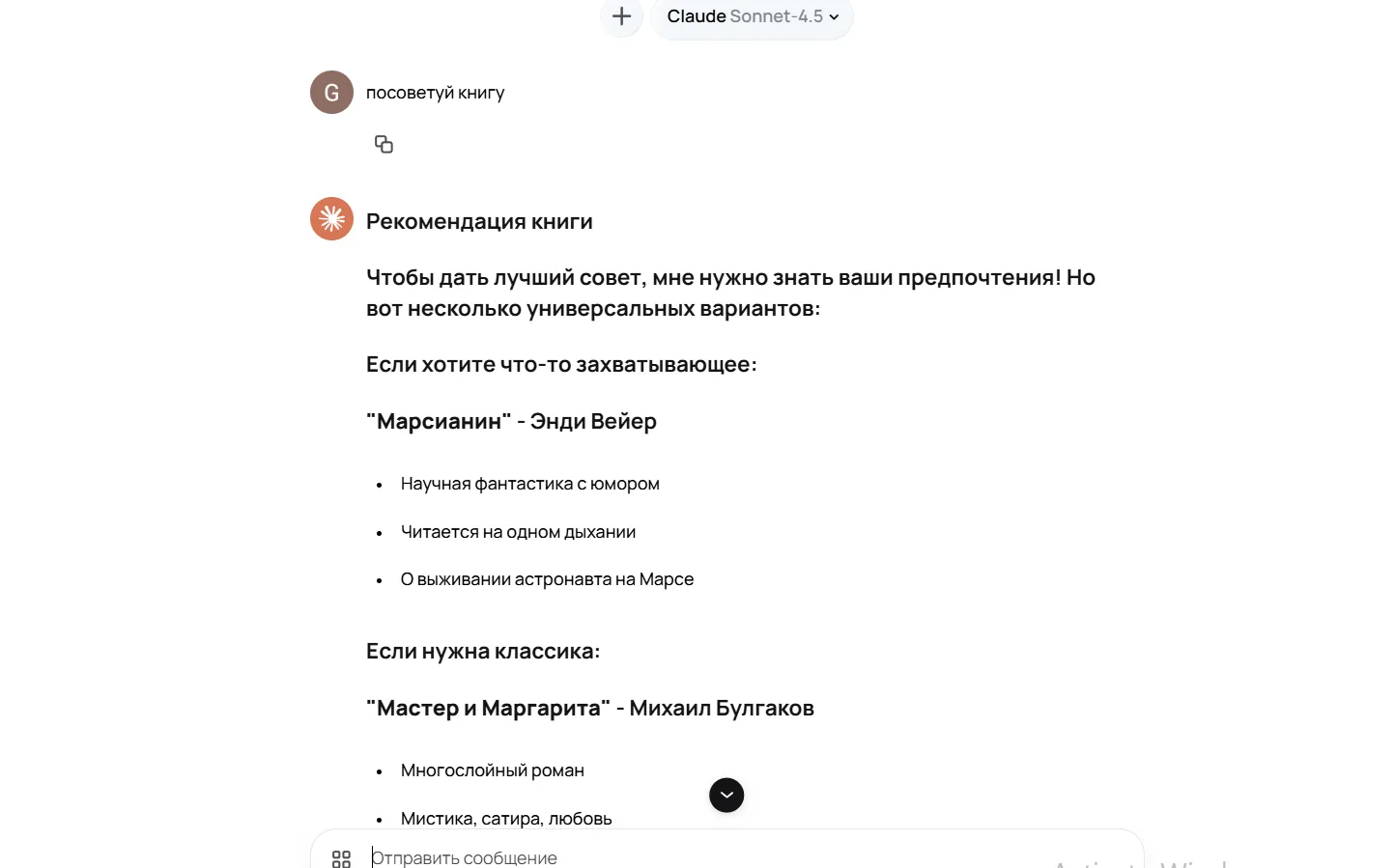
Clarity and specificity are what matter most to an AI model. Formulate your task unambiguously: describe the desired result in detail so the AI understands exactly what you want to know or receive. For example, instead of "Recommend a book," it's better to write "Recommend three books on personal growth and briefly explain why each one is useful."
Specify the format you want
Another useful technique is to set the format and structure of the answer (a list, a table, plain text) so the AI sticks to the style you need. For example, ask the model to present its result as a list or a table, as in this example.
Following these principles will let you improve the quality of the answers you get from AI models and make using them more productive and effective.
Common mistakes when writing prompts
Even with a basic understanding of how to write prompts, it's easy to make mistakes that cause the model to generate irrelevant answers. Let's look at the most common mistakes and how to avoid them.
Ambiguity
Ambiguity happens when a request is unclear or has several possible interpretations. The model may give an answer that doesn't match what you expected.
For example, the prompt "Tell me about marketing" can be interpreted many different ways: digital marketing, traditional marketing, social media marketing, and so on. To avoid this, add context and make the request specific: "Tell me about social media marketing strategies for B2B companies in the crypto industry, targeting the US and European markets."
Overly complex requests
The prompt "Explain how machine learning works, describe its applications in medicine, and cover the possible ethical issues" is too complex. It's better to split it into several separate questions:
- "Explain how machine learning works."
- "Describe the applications of machine learning in medicine."
- "What ethical issues can arise from using machine learning in medicine?"
Avoid layering too many things into one prompt so the model doesn't lose the thread of the task. Stick to the principle: one request, one goal. Too many conditions scatter the model's "attention." The fewer unnecessary layers you pile on, the more precisely each point gets addressed.
Lack of context
Context shapes the result. Without background information, the model will give a response that's too abstract. Specify the goal, the target audience, and the conditions of the task — this turns a generic answer into a ready-made solution. For example, the prompt "How do I increase sales?" can be improved to: "What proven go-to-market strategies exist for a new tech product in a competitive market?"
Tools and techniques for generating prompts
80% of working effectively with AI comes down to choosing the right prompting methods. Below are 4 such methods to help you get quality results faster.
Using examples in your request
Include examples in the body of your task to clearly illustrate what you expect. For example, you could start a prompt like this: "You are an experienced content marketer. Write 3 ad headlines for a healthy-eating post on a nutritionist's Telegram channel. The target audience is women aged 25-40. The headlines should be attention-grabbing and highlight the benefits. Example of a good headline: 'Five healthy snacks that will energize you better than coffee.'"
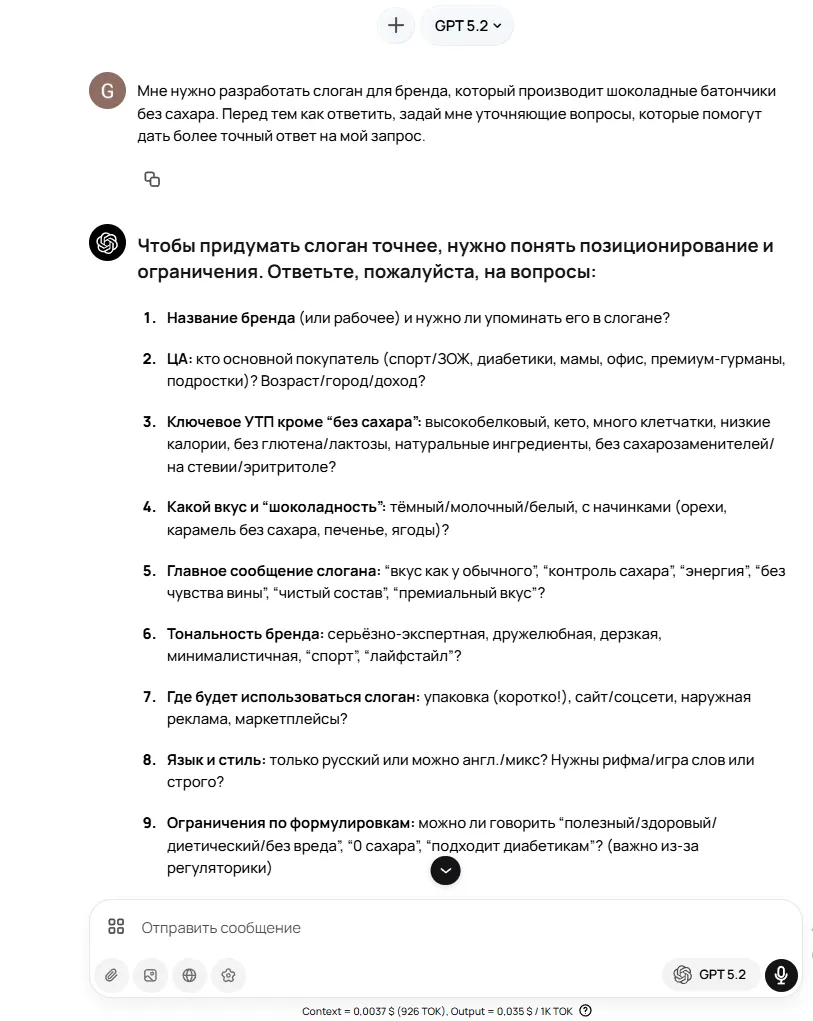
Ask the AI to ask clarifying questions
Let the AI ask questions before it starts working, so it can pin down the request. This helps avoid double meanings.
For example, you could write in your chat: "Before you answer, ask me any clarifying questions that would help you give a more accurate response to my request."
This lets the model gather additional information and give a more precise answer.
Ask the AI to build the prompt for you
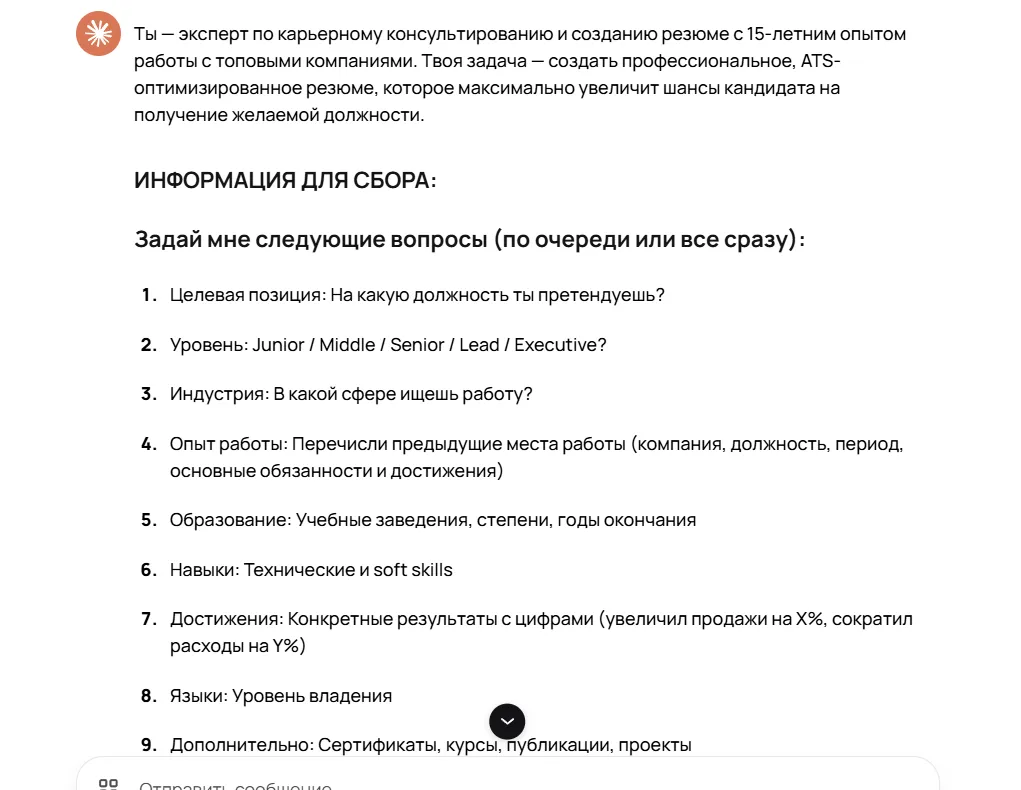
The models available on GPTunneL can write various prompt phrasings for you themselves, depending on your task. For example, we used an AI to generate a prompt and asked the model to come up with a prompt that would help build the perfect resume. See what we got in this chat.
Bringing in a prompt engineer for complex tasks
A prompt engineer acts as an architect of intelligent systems, building flexible, effective AI-based tools for business and research. Using these tools and techniques, you can improve your prompt-writing process and get more accurate, useful answers from AI models.
For example, if you need to design a complex algorithm, run deep data analysis, or integrate AI into business processes, ask a prompt engineer to propose phrasings, approaches, and systems of interconnected prompts.
A specialist can set up pipelines where the output of one prompt becomes the input for the next, forming a kind of information-processing conveyor. Such systems let you automate complex tasks that require the sequential application of multiple AI models and algorithms.
Examples of good prompts for ChatGPT
To better understand how to write effective prompts, let's look at a few examples of successful requests and break down why they work. These examples will show you in practice how to apply the principles and techniques described in the previous sections.
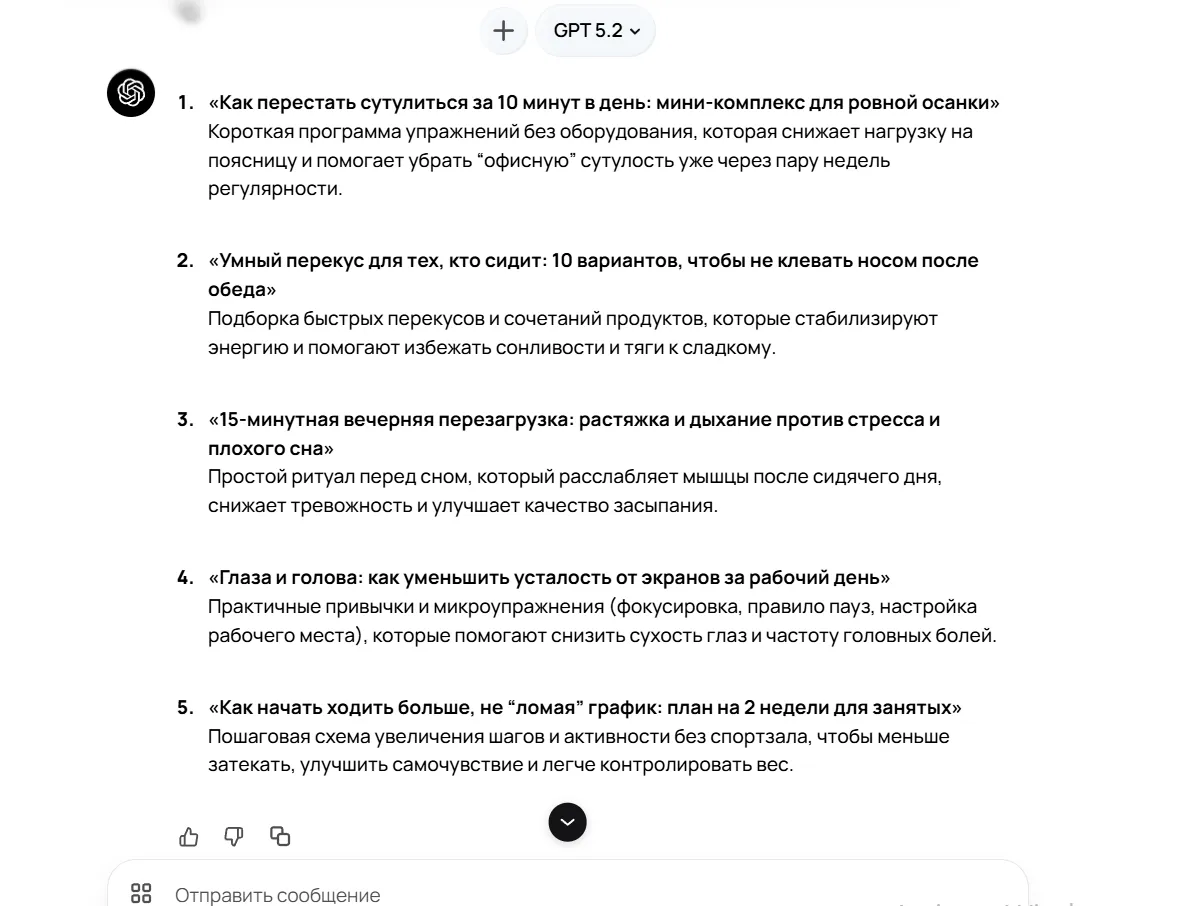
Example 1: A prompt for generating ideas
Prompt: "You are an experienced copywriter. Write 5 blog post ideas on the topic of healthy living. The target audience is young people aged 25-35 with a sedentary lifestyle. Each idea should be briefly described in 1-2 sentences and include a specific benefit or problem it solves. Example of a good idea: '7 simple office exercises that relieve neck and back tension'."
→ Try this prompt in GPT-5.2_ to test the model's ability to generate quality ideas._
Why this is a good prompt:
- A clear role is set: experienced copywriter.
- A specific task is stated: generate 5 blog post ideas.
- The target audience and its traits are defined: young people aged 25-35 with a sedentary lifestyle.
- An example of a good idea is given as a reference point: 7 simple office exercises that relieve neck and back tension.
Example 2: A prompt for writing an academic paper
Prompt: "You are an expert in writing academic papers. Your task is to help me write a paper on the topic 'The place of philosophy in human culture.' Let's work step by step. Before we start writing the paper, let's build an outline using this structure:
- Introduction: a brief introduction to the topic, its relevance, and the goals and objectives of the paper.
- Main body: divided into chapters and sections that examine aspects of the topic in detail.
- Conclusion: a summary, conclusions on the topic, and an assessment of the results achieved.
Build the outline. Keep in mind the paper's length: 11-15 pages".
→ Send this prompt in a chat with Gemini 3 Pro_ to test the model's scientific-reasoning abilities._
Why this is a good prompt:
- A clear role is set: expert in writing academic papers. This helps the AI focus on a specific field of knowledge and text format.
- A specific task is stated: build an outline on the given topic. This sets the direction of the work and the expected result.
- The structure of the paper is defined: introduction, main body, conclusion, plus what should go in each section. This gives the AI a clear reference point for building the outline.
- The expected length of the paper in pages is specified. This is an important parameter that affects how detailed and in-depth the outline should be.
- The paper's topic is phrased clearly and specifically. This lets the AI focus on exactly this question without drifting into related topics.
By the way, we've already written an article on how to write a term paper using ChatGPT. Worth checking out if that topic is relevant to you!
Example 3: A prompt for building a sales funnel
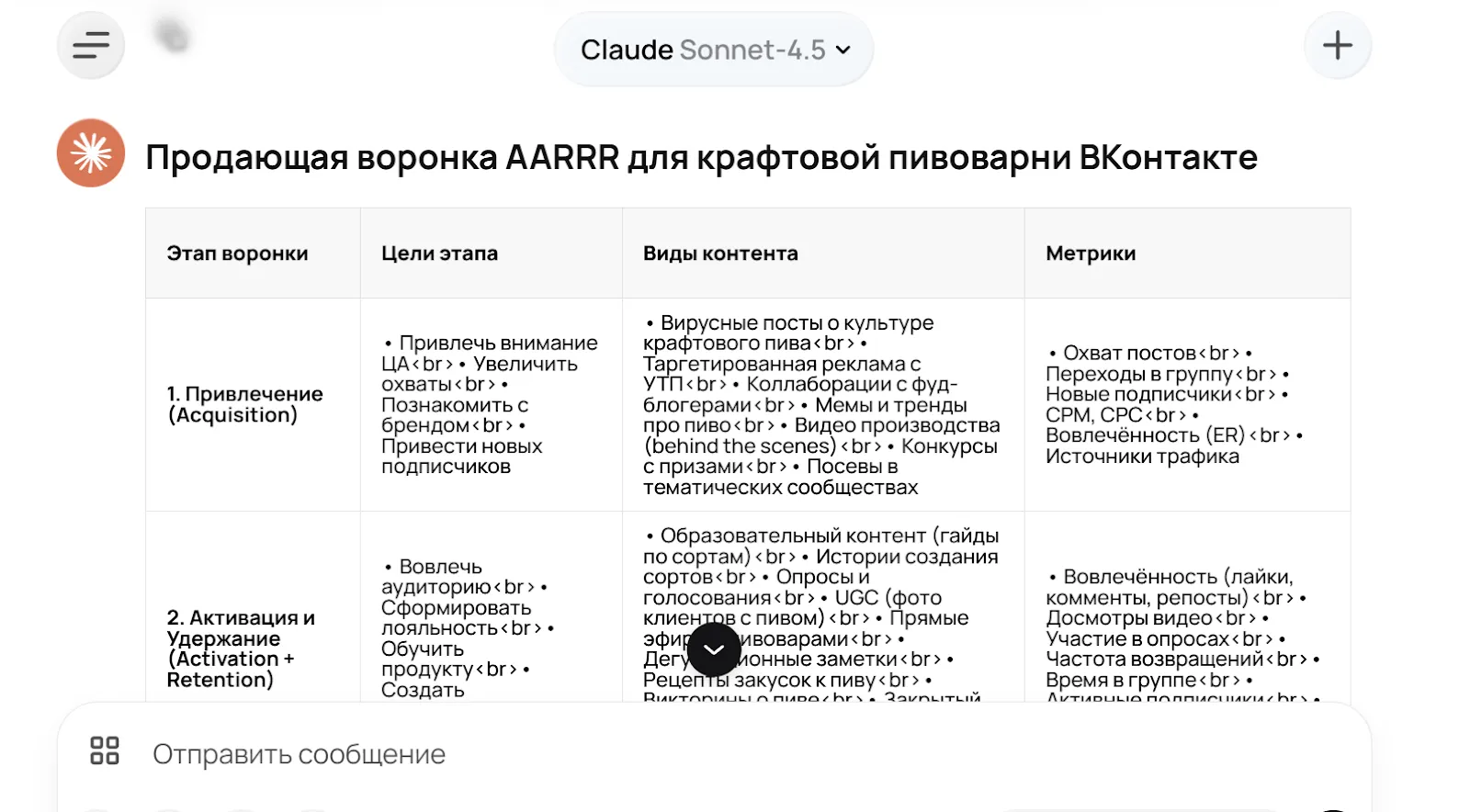
Prompt: "You are an experienced SMM manager. You're working on a project for a craft brewery. The target audience is young people who value unique, authentic drinks. They often look for new experiences and are willing to pay more for high-quality, interesting drinks.
You need to design the structure of a sales funnel for our VK community using the AARRR framework. Keep in mind that the framework consists of 5 stages (Acquisition, Activation, Retention, Revenue, Referral. But for our funnel we're merging the Activation and Retention stages) that account for the customer journey and their level of familiarity with the product.
Design the funnel and present the result as a table, with the funnel stage across the top (Acquisition, Activation and Retention, Revenue, Referral) and, going down, Stage Goals, Content Types, Metrics)".
→ Open a chat and see how Claude 4.5 Sonnet handles this prompt.
Why this is a good prompt:
- Clear definition of role and context: the prompt immediately sets the role (experienced SMM manager) and the context (project: craft brewery), which helps clarify the task and the target audience.
- Definition of the target audience: describing the target audience (young people who value unique, authentic drinks) helps focus on their specific needs and preferences, which matters for building an effective strategy.
- Use of the AARRR framework: the prompt introduces a specific framework (AARRR), a popular, proven method for building a sales funnel. This provides structure and direction for completing the task.
- Clear instructions on the output: the prompt requires the result as a table with specific columns (Funnel Stage, Stage Goals, Content Types, Metrics), which makes the task easier to understand and complete.
Wrapping up
In this article we covered how to properly compose prompts for working with language models, discussed the core principles of prompt writing, common mistakes to avoid, and useful tools and techniques for generating high-quality requests. We hope these tips help you make better use of AI's capabilities and get better results from it.
And you can put all these tips into practice in our convenient service GPTunneL, which brings together the most advanced models in one place, such as GPT-5.2, Claude 4.6, Gemini 3 Pro, and others.
In GPTunneL you can also use the LLM Arena tool, which lets you compare different language models in real time. This helps you pick the best model for your tasks and get the most out of using AI.