

Just a couple of years ago, the idea of writing a term paper with ChatGPT seemed like science fiction. Today, artificial intelligence can easily handle text of any complexity — whether it's a research paper, and even more so an essay, article, or piece on a given topic. Direct proof of this is a thesis a student wrote relying on ChatGPT's help.
In fact, ChatGPT for students makes putting together almost any content much easier. The bulk of student work, especially research work, is essentially "finding out what has already been said on the topic." Your own research and conclusions can usually be fit into a few presentation slides.
This is exactly where ChatGPT helps — essentially "filling the space" in your work by citing other researchers' work based on your prompts. Of course, there are pitfalls, which we'll get into now. To save time, let's skip the background on how the chat works under the hood and get straight to the point.
Which version of ChatGPT is better?
Imagine you have some academic project and you've decided to use ChatGPT to write it.
You'll immediately run into two problems:
- The official version of ChatGPT isn't accessible everywhere. In many places you need not just a VPN, but also a foreign phone number to sign up. This is easily solved with our models in GPTunneL, where we provide access to ChatGPT without the hassle.
- You need to decide which version of ChatGPT to use. There are currently 3: ChatGPT3.5 (free), ChatGPT3.5-turbo, and ChatGPT4. We covered their differences in detail, with clear examples, in this article: /blog/gpt-3-vs-gpt-4/
In short, the older the version, the worse it performs. Right now, "GPT chatbots" are spreading widely on Telegram. They usually run on an outdated version that is, frankly, not very smart: it's slow, writes text clumsily, doesn't remember conversation history, and makes plenty of mistakes. For academic work, that can become a serious problem.
ChatGPT3.5 is a solid workhorse — not brilliant either, but it writes noticeably better text and makes fewer mistakes.
And ChatGPT4 is a genuine standout in its niche, with a decent approximation of wit and creative thinking. A tricky task or an unusual project? It handles even the trickiest assignments well, while carefully selecting its sources, so you barely have to worry about factual accuracy.
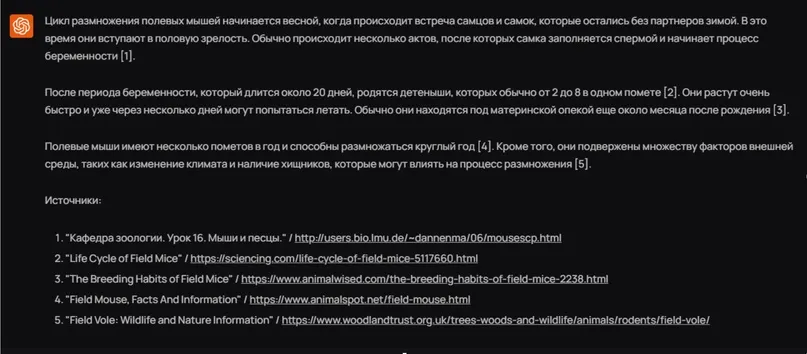
Here's another clear illustration of the difference between ChatGPT3.5 and ChatGPT4 answers.
We create an identical prompt:
Describe the breeding cycle of field mice using at least 5 credible sources. Don't use Wikipedia. List the sources you used.
ChatGPT 3.5
ChatGPT 4
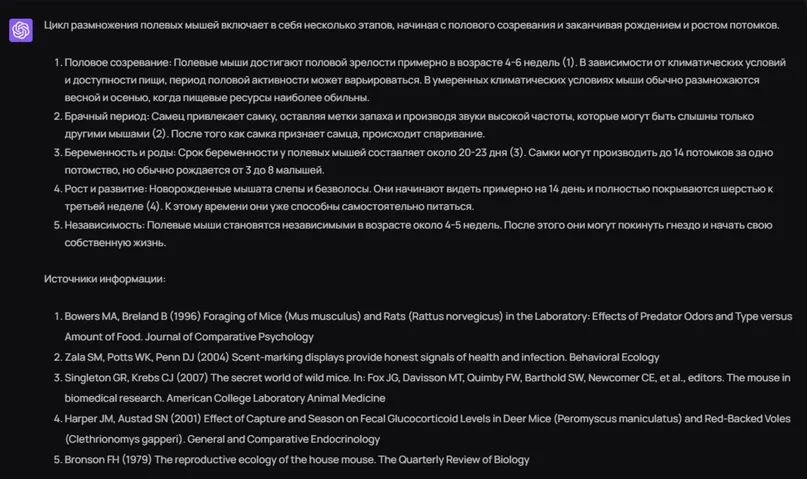
As you can see, the sources each chat picked, the length of the answers, their style, and structure differ significantly. And the longer you work with ChatGPT4, the more obvious the "intelligence" gap between it and the older versions becomes.
How to ask ChatGPT to get a good answer?
It's important to understand that, by default, ChatGPT tries to answer a question as thoroughly as possible, drawing on every source available to it online. So when using the chat, keep a few basic principles in mind:
1) Think through the goal you want to use the neural network for. It can not only generate text or rewrite it, but also create images and even write code. You may find you can expand the list of tasks you "delegate," and break current tasks down into pieces that are more "understandable" for ChatGPT.
2) Phrase your question with maximum context and all relevant conditions. The more abstract the question, the worse and more meaningless the answer will be. To avoid wasting hours searching through and rereading answers that don't fit, it's better to work out your prompts in detail beforehand: clarify where to look and where not to, what style and format you need the answer in, how detailed it should be, and so on. Your academic advisor or library staff can point you to the literature ChatGPT should draw on.
3) Check that the sources cited in your paper actually exist. As mentioned above, ChatGPT will by default use every source available to it without carefully verifying its reliability (although version 4 is more dependable in this regard). Made-up sources, if discovered during review, mean a bad reputation and a direct path to a retake. So be sure to google whether the article ChatGPT cites actually exists.
4) Carefully reread the final text.
Make sure the logic and structure of the paper hold up throughout, and that everything is written in clear, "human" language. Otherwise you might run into unpleasant surprises after submission or during your defense.
How do you make sure the paper gets accepted?
A paper can get sent back for revision for a thousand reasons, but the real problem only arises if you write nothing at all. No GPT chat can simply be "fed" a term paper topic and produce a perfect result. If you want a good grade, you'll still need to spend some time crafting prompts, as well as editing and rereading the resulting text to polish it. But ChatGPT will take on 80% of the tedious routine, and writing a solid term paper will take you 1-2 days instead of 6 months. And even if you're told "this part and that part need rework," you'll be able to do it quickly, since you already have the text base, as well as experience working with gptunnel.ru. Don't be afraid to bring modern technology into your studies!