

OpenAI has developed a new series of AI models designed to think longer before responding. They can reason through complex tasks and solve harder problems in science, coding, and math than previous models.
How it works
The company trained the models to spend more time thinking through problems before answering, much like a person would. During training, they learn to refine their thought process, try different strategies, and recognize their own mistakes.
In our tests, the latest model update shows results comparable to graduate-level performance on challenging benchmark problems in physics, chemistry, and biology. We also see it excel at math and programming — it's interesting to compare it with Sonnet 3.5. On a qualifying exam for the International Mathematical Olympiad (IMO), GPT-4o solved only 13% of problems correctly, while the reasoning model scored 83%. Its coding abilities were evaluated in competitions and reached the 89th percentile on Codeforces. You can read more about this in OpenAI's technical research.
As an early model, it doesn't yet have many of the features that make ChatGPT useful, such as web browsing for information and uploading files and images (Vision). For many common use cases, GPT-4o and Sonnet 3.5 will remain more effective in the near term.
Who is o1 for?
Improved reasoning capabilities can be especially useful if you're solving complex problems in science, programming, math, and related fields. At GPTunneL™ we see huge potential for applying these technologies across many domains.
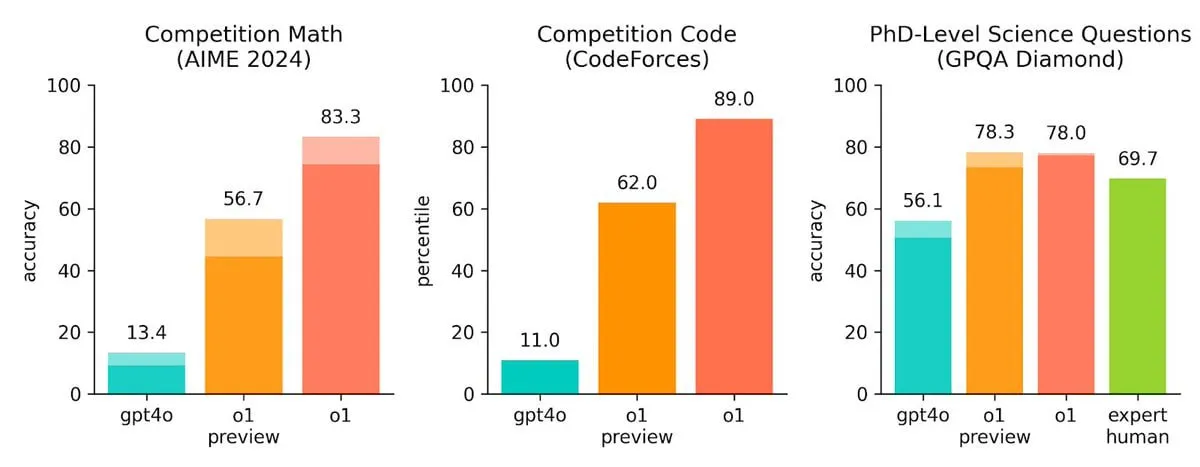
Statistics on the ChatGPT o1-preview model
For example, our clients in healthcare can use advanced models to annotate cell sequencing data. Physicists can generate the complex mathematical formulas needed for quantum optics. And developers across all fields get a powerful tool for building and executing multi-step workflows.
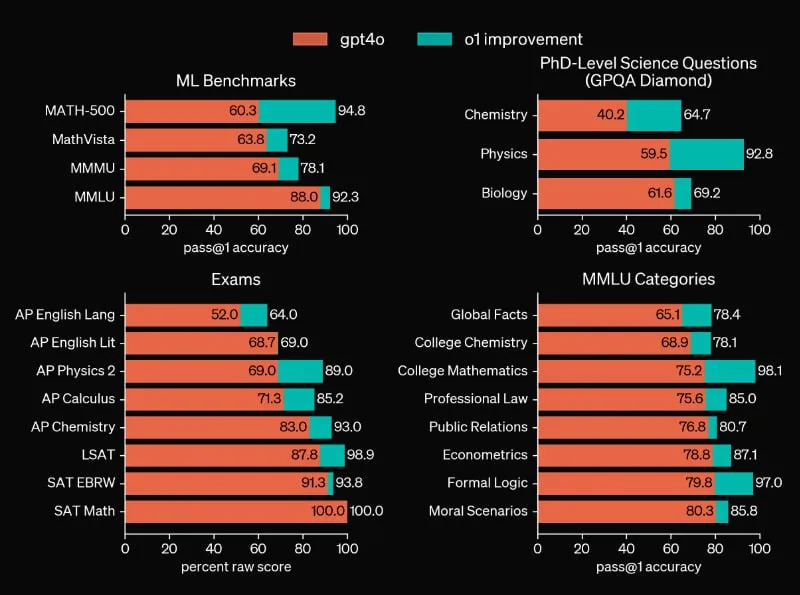
Comparison of GPT-4o and o1-preview models
We're committed to making these advanced AI capabilities accessible to a wide range of professionals, helping them solve the most complex problems in their fields. Our service lets you tap into the potential of advanced language models without needing to understand the intricacies of how they work.
OpenAI o1-mini
The o1-mini model is a faster and more affordable version of the reasoning neural network, particularly effective for programming tasks. As a smaller version of o1, it offers several advantages:
- Cost: o1-mini is 80% cheaper than o1-preview, making it a powerful and cost-effective tool.
- Specialization: The model is particularly well suited for tasks that require logical reasoning but don't need broad world knowledge.
- Speed: Thanks to its smaller size, o1-mini runs faster, which is critical for many developers.
At GPTunneL, we believe o1-mini will become a great choice for many of our clients going forward, especially those working on projects where processing speed and cost efficiency matter. This model gives developers access to cutting-edge AI capabilities for programming at an affordable price.
Is the model already available?
At the moment, these models are in an early preview stage at GPTunneL™. It's important to note that the API for these models isn't yet available to the general public, but you can already try the model in the interface in GPTunneL.
Let's take a look at an exciting video showcasing the capabilities of the new model. The video shows a person using AI to build a game about a squirrel. It's a great example of how new models can be applied in creative processes and game development. The video will give you a sense of the potential of these tools and inspire new ideas for your projects.